You’ve probably heard laser hair removal described as life-changing by some people and overpriced by others. Both camps have a point depending on the situation. Laser hair removal vs waxing isn’t a simple answer, it depends on your hair, your skin, how your body responds, and what a realistic cost comparison looks like over time. At 901 Aesthetics in Germantown, Lauren McCann, MSN, RN, CRNA, builds treatment plans around all four factors before recommending anything.
Laser vs Waxing: Long-Term Results Compared
Laser lasts significantly longer. After completing a full treatment series, most clients see 70–90% permanent hair reduction in the treated area, and what grows back tends to be finer and lighter. Waxing produces smooth skin for 3–6 weeks before the cycle starts over, and it keeps starting over indefinitely, with no end point.
The one situation where this changes: grey, white, blonde, and red hair. Laser targets melanin in the follicle, and these hair colors carry too little of it for the laser to work reliably. For everyone else, laser delivers the longer-lasting result by a significant margin. Waxing asks for twelve or more appointments a year with no change in what you get at the end of each one. Laser asks for six to eight sessions and then mostly leaves you alone.
How Waxing and Laser Hair Removal Actually Work
Waxing and laser both remove hair you can see. What separates them is what happens to the follicle underneath, and that difference is what determines whether you are doing this again in four weeks or done with it in four months.
How Waxing Works
Warm wax adheres to the hair and gets pulled away from the skin in one motion, removing the hair from the root. The follicle stays intact and immediately starts producing the next hair. Results last 3–6 weeks. Works on all hair colors and skin tones, no candidacy assessment needed.
How Laser Hair Removal Works
A concentrated beam of light targets the melanin in the hair follicle, converts to heat, and damages the follicle’s ability to regrow hair. Because hair grows in cycles, multiple sessions are needed to catch follicles during their active growth phase. Over a full series, treated follicles produce progressively less hair until regrowth drops significantly or stops. Session spacing matters here: compressing appointments defeats the purpose because hair that isn’t in an active growth phase won’t respond to the laser, which is why the 4–6 week gap between sessions is clinical, not arbitrary.
Laser Hair Removal vs Waxing: Side-by-Side Comparison
Here is how the two methods compare across the factors that actually determine which one fits your situation.
| Factor | Laser Hair Removal | Waxing |
|---|---|---|
| How it works | Targets the hair follicle with light energy | Pulls hair from the root mechanically |
| Results longevity | 70–90% permanent reduction after full series | 3–6 weeks before hair returns |
| Sessions needed | 4–8 sessions spaced 4–6 weeks apart | Ongoing every 3–6 weeks indefinitely |
| Pain level | Warm snap per pulse, less than waxing for most | Sharp pulling sensation, same intensity every time |
| Cost per session | $150–$400 per area (901 Aesthetics pricing) | $50–$80 per appointment |
| Cost over 5 years | $1,200–$2,700 for a full series plus touch-ups | $3,900–$6,240+ with no end point |
| Skin tone range | Wide range with the right device | All skin tones |
| Hair color range | Dark hair only (grey/white/blonde/red vary) | All hair colors |
Long-Term Results: What Actually Changes
Waxing keeps you smooth for a few weeks at a time, but the follicle remains undamaged and restarts the growth cycle every time. Laser disrupts that cycle. After each session, the targeted follicles produce hair that grows back finer and sparser. By the end of a full series at 901 Aesthetics, most clients see a dramatic reduction, and the annual touch-up or two that follows is nothing like the 12-plus waxing appointments the same period would have required.
What the Cost Looks Like Over Time
A waxing appointment for underarms and standard bikini runs $80–$150 at most salons. Over a year, that adds up to $960–$1,800 and next year the number resets. A 6-session laser package for the same areas at 901 Aesthetics runs $1,200–$2,700 total. Most clients hit the cost crossover point somewhere around year two, and after that the gap only grows. Waxing keeps billing. Laser stopped a long time ago.
Cherry financing at 901 Aesthetics spreads a laser series into monthly payments. Call (901) 221-1256 to ask what that looks like for your specific treatment area.
Pain Comparison: Laser vs Waxing
Waxing consistently scores higher on discomfort than laser for most clients. The experience is meaningfully different between the two, and which one feels worse depends on the area and your tolerance.
What Waxing Actually Feels Like
The sensation is a sharp pulling from the root, and it doesn’t get easier with repetition. Brazilian, upper lip, and underarm areas carry the most intensity. You feel it every appointment, at the same level, with no reduction over time. Sensitive skin often stays red and irritated for 24–48 hours after.
What Laser Feels Like at 901 Aesthetics
Most clients describe it as a brief warm snap, similar to a rubber band flick, that fades within a second or two. 901 Aesthetics uses elōs Plus, which combines radiofrequency and optical energy to reach the follicle without relying purely on surface heat. That combination makes the treatment more tolerable than standard diode laser for most people. 901 Aesthetics offers numbing cream for sensitive areas at an additional cost if you want extra comfort going in.
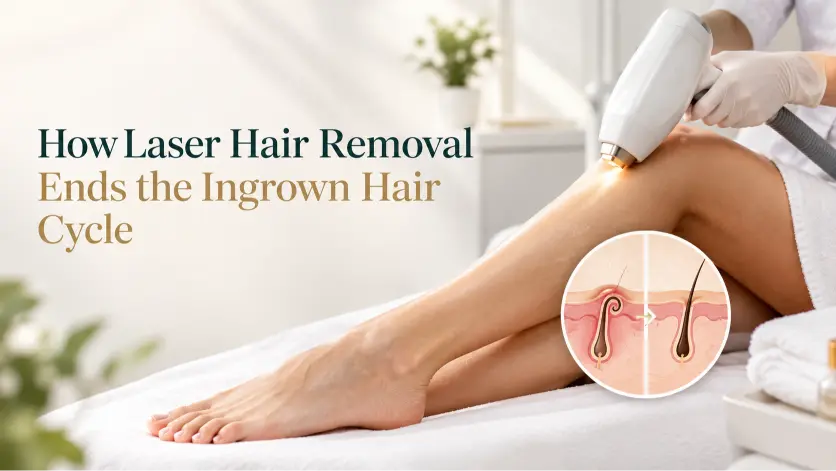
How Laser Hair Removal Ends the Ingrown Hair Cycle
Waxing pulls hair cleanly from the root. The problem is what happens next. The follicle produces new hair that has to break through the skin surface to emerge, and when that hair grows at an angle or gets trapped under dead skin cells, it becomes an ingrown. Removing the hair doesn’t change how the next one grows back.
Why Waxing Keeps Producing Ingrown Hairs
Every new hair that regrows after a wax faces the same follicle geometry as the last one. If that follicle tends to produce hair that curls or grows sideways, waxing it again produces the same result. Bikini lines, underarms, and the upper lip are the most common problem areas because the skin in these areas is thinner, the hair tends to be coarser relative to the pore, and the pulling direction during waxing often works against the natural grain of hair growth. Repeated waxing doesn’t resolve the pattern. The follicle geometry doesn’t change regardless of how many times the hair gets removed from it.
How Laser Breaks the Ingrown Cycle
Laser progressively damages the follicle across sessions, and the hair that grows back comes in finer and slower each time. Finer hair rarely traps itself under the skin because there simply isn’t enough mass behind it to curl back and re-enter the follicle opening. Once the follicle produces little to no hair, the ingrown cycle breaks entirely. For clients dealing with facial hair ingrowns specifically, laser hair removal for facial hair confidence covers what that improvement looks like in practice.
Which Candidates See the Best Laser Results
Hair color, skin tone, and what’s driving your hair growth all factor into which approach works and how many sessions you’ll actually need. At 901 Aesthetics, Lauren McCann, MSN, RN, CRNA, reviews all three at the consultation before recommending a device or mapping out a session plan. The two laser devices at 901 handle different combinations, which is why the match matters more than a one-size approach.
Dark, Coarse Hair: Where Alpha Pro Excels
Alpha Pro runs an 808nm diode laser paired with 3D IPL technology and PowerMotion for fast, efficient sessions on dark, coarse hair, which is exactly the combination standard laser was originally designed to treat. It also delivers Bright & Tight technology, which adds skin tightening and helps calm active acne at the same time. For patients building a broader treatment plan, the IPL component adds a skin benefit layer that waxing never produces.
Lighter Hair, Darker Skin, or Previous Laser Disappointments
Standard diode laser depends on melanin contrast between hair and skin. When that contrast drops because of darker skin tones, finer hair, or lighter hair, the laser struggles to isolate the follicle without affecting surrounding tissue. elōs Plus adds radiofrequency energy to the optical beam, which targets the follicle through a second mechanism that doesn’t rely on that contrast. It’s why clients who were told laser wouldn’t work on their skin often get better results at 901 Aesthetics than they expected.
Hormonal Hair Growth and PCOS
Laser targets what the follicle produces regardless of what’s driving that production. For patients with PCOS or hormonally influenced hair growth, the treatment works the same way mechanically, but fluctuating hormones can reactivate follicles that were previously treated. That tends to mean one or two extra touch-up sessions per year rather than a full restart, and it responds well when you plan for it from the beginning instead of treating it as an exception. Bringing that up at the initial consultation lets Lauren McCann build realistic expectations into the plan before the first session, not after.
What to Expect Across Your Laser Series
Most people expect to see dramatic results after the first session and feel disappointed when the change is subtle. That reaction makes sense if no one explained how the series actually works.
Sessions One and Two
The first session targets follicles in their active growth phase. In the two to three weeks that follow, treated hairs detach and fall out naturally as the damaged follicles stop holding them. The skin in the treated area looks cleaner and smoother, but there is still significant hair present from follicles that weren’t in the right phase during that first session.
Sessions Three Through Five
This is where the compounding starts to show clearly. Each session catches the follicles that were dormant during previous treatments. By the midpoint of the series, most clients notice that regrowth is visibly thinner and slower than before they started. The interval between sessions also becomes more noticeable. You get several weeks of near-smooth skin rather than a few days.
After the Full Series
Hair that grows back after the series comes in finer, lighter, and far less dense than what you started with. Most clients at 901 Aesthetics schedule one touch-up session annually to address any follicles that partially recovered. That is the maintenance reality: one appointment a year versus twelve or more.

Four Situations Where Waxing Still Makes More Sense
Laser isn’t the right answer for everyone in every situation. Four specific scenarios where waxing makes more sense:
Your Hair Is Grey, White, Blonde, or Red
Laser targets melanin in the hair follicle. Grey, white, blonde, and red hair carries so little of it that most laser systems struggle to distinguish the follicle from the surrounding tissue. Some clients with these hair colors see partial improvement, but results vary enough that waxing remains the more reliable option. It removes hair mechanically, so pigment doesn’t factor in at all.
The Upfront Budget Is Genuinely Limited Right Now
A full laser series requires paying for multiple sessions before the long-term benefit compounds. Waxing costs $50–$80 per appointment with no commitment. If the budget is tight right now and Cherry financing isn’t the right fit, waxing is the honest short-term answer.
You Need Smooth Skin Before a Specific Date
Laser works in sessions spaced 4–6 weeks apart because the hair growth cycle dictates timing. You cannot compress the series to hit a date. If you have a specific event coming up in the next two to three months and want smooth skin reliably before it, waxing is the faster tool. Book laser after the event and let it run its full course without a deadline attached.
You Are Mid-Laser Series and Hair Is Still Growing
Waxing between laser sessions removes the hair root the laser needs to target, which reduces effectiveness. Shaving is the correct method between sessions. If you are early in a series and hair is still visibly present between appointments, shaving handles it.
Laser Hair Removal in Germantown and the Memphis Metro
901 Aesthetics sits at 9057 Valley Crest Lane, Suite 101, Germantown, TN 38138, minutes from the Poplar Avenue corridor. Lauren McCann, MSN, RN, CRNA, sees laser hair removal clients from East Memphis, Collierville, Cordova, Bartlett, Lakeland, Arlington, Olive Branch, and Southaven. 901 Aesthetics holds the 2024 Community Choice Award and is Voted #1 Memphis Most MedSpa and Laser Center.
One consultation confirms which device fits your hair and skin combination and gives you a realistic session count before you commit. Call (901) 221-1256. For patients combining hair removal with other skin services during the same visit, laser skin resurfacing is available at the same location.
If the waxing vs. laser comparison has been running in the back of your mind for a while, a consultation at 9057 Valley Crest Lane is where you get a specific answer for your hair and skin, not a general one.
Frequently Asked Questions
Share This Story, Choose Your Platform!
Related Posts