Sunscreen every day, retinol every night, the brightening serum your esthetician recommended. You’ve done all of it. The spots are still there. The lines around your eyes are deeper than they were two years ago. At some point the products stop being enough, and the question stops being “which serum should I try next” and starts being whether laser skin resurfacing is worth it for fine lines and sun damage in a way that actually produces a visible difference.
Laser Skin Resurfacing: Does It Actually Deliver for Fine Lines and Sun Damage?
For most people dealing with these two concerns, yes. Laser resurfacing produces changes in the skin’s structure that no topical product can replicate, because it works in the dermis where collagen lives, not at the surface where serums and creams reach. The distinction matters because fine lines and sun damage both originate below what you can see, which is exactly why treating the surface only gets you so far.
What determines whether it’s worth it for your specific skin comes down to two things: choosing the right technology for what you’re actually trying to fix, and going in with a realistic picture of what the results look like and when.
Why Fine Lines and Sun Damage Respond Differently to Laser
Most people searching this topic treat fine lines and sun damage as one problem. They’re not. They’re two distinct changes happening in the skin through different biological processes, and they respond to different mechanisms.
What Sun Damage Actually Is and Why Topicals Stop Working
Years of UV exposure trigger overproduction of melanin in the deeper layers of the skin. That melanin accumulates unevenly and eventually becomes visible as brown spots, age spots, uneven tone, and the kind of discoloration that doesn’t respond to brightening serums no matter how consistently you use them. The damage is sitting below the epidermis. A serum can support cell turnover at the surface, but it can’t break up what’s already concentrated in the dermis. Laser resurfacing for sun damage targets the melanin directly with light energy, converting it to heat that breaks up the pigmented cells and allows the body to clear them. That’s a fundamentally different mechanism than anything in a bottle.
What Causes Fine Lines and Why Collagen Is the Real Target
Fine lines form when the structural scaffold underneath the skin starts to weaken. Collagen production slows after the mid-20s, and the dermis gradually loses the firmness that kept the skin surface smooth. Topical retinoids stimulate some surface-level collagen activity, which is why they help. They work slowly and only at a depth that laser resurfacing can exceed significantly. Sublative rejuvenation via the elōs Plus creates a controlled wound-healing response deep in the dermis, triggering the body to produce collagen at a rate and depth that topicals cannot reach. Nouvaderm does the same through microthermal zones created by its 1927nm Thulium wavelength.
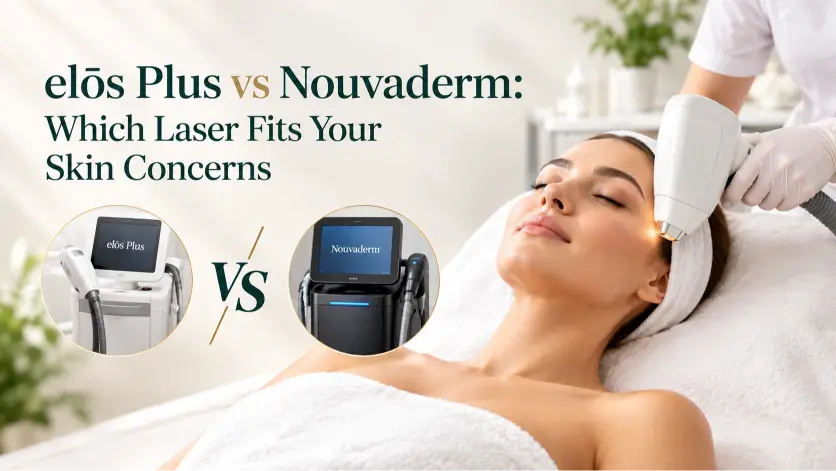
elōs Plus vs Nouvaderm: Which Laser Fits Your Skin Concerns
Not every skin concern needs the same level of correction. Pushing someone toward a more intensive treatment than their skin requires doesn’t produce better results. It just produces more downtime and a higher bill for something a gentler approach would have handled. At 901 Aesthetics, Lauren McCann, MSN, RN, CRNA, uses two distinct laser platforms precisely because different patients need different levels of correction, and matching the device to the actual concern is what makes the difference between results that feel worth it and results that disappoint.
elōs Plus Sublative RF: Fine Lines, Texture, and Overall Skin Quality
The elōs Plus sublative rejuvenation treatment delivers controlled bipolar RF energy through a matrix grid into the deeper skin layers with minimal disruption to the surface. The result is a significant boost in collagen and elastin production that works from the inside out. It treats fine lines and wrinkles, age spots, sunspots, freckles, large pores, uneven skin tone, mild skin laxity, acne scars, vascular lesions, and broken capillaries. Treatment takes about 20 minutes, though the full visit is closer to an hour including prep and post-care. A minimum of three sessions spaced 4–6 weeks apart is the standard starting point, and it can be combined same-day with an IPL photofacial for patients dealing with redness, broken capillaries, or significant pigmentation alongside texture concerns.
Nouvaderm: When More Intensive Correction Is the Goal
Nouvaderm uses a 1927nm Thulium laser to create microthermal zones throughout the skin at greater depth than the elōs Plus sublative. It runs in non-ablative, sub-ablative, and ablative modes, so the treatment intensity gets dialed to what the skin actually needs rather than using one fixed setting on everyone. It treats fine lines, sun damage, pigmentation, melasma, acne scars, stretch marks, and uneven tone and texture. It also treats areas beyond the face: neck, chest, arms, hands, shoulders, and legs. Sessions run 30–60 minutes. Results become visible within a week, and collagen improvement continues for 3–6 months after the final session in a series.
Which One Fits Your Skin?
Moderate concerns like fine lines starting to appear, some sun spots, and uneven texture fit the elōs Plus sublative as a strong starting point. More significant correction, including pronounced pigmentation, melasma, deeper lines, acne scars, and chest or neck sun damage, fits Nouvaderm or a combination approach. A consultation confirms the right fit, not a website. And the honest answer sometimes means starting with the less intensive option rather than the most aggressive one.
What Laser Resurfacing Cannot Fix
Laser resurfacing produces real, measurable improvement in fine lines, sun damage, texture, and tone. It doesn’t fix everything, and the patients who walk away most satisfied are the ones who understood what the treatment was actually designed to address before they started.
Deep static folds, the kind that sit in the skin even when the face is completely at rest, respond better to injectables than to laser. Significant volume loss in the cheeks, temples, or lips needs filler or a biostimulator, not a resurfacing treatment. Pronounced skin laxity along the jaw and neck, beyond mild looseness, responds better to devices specifically targeting skin tightening or to surgical consultation.
Active acne is a contraindication for most laser protocols. If skin is currently breaking out, treatment gets postponed until acne is controlled, because treating inflamed skin with laser energy increases the risk of complications and inconsistent results.
Very dark skin tones require specific consultation before any laser treatment. The elōs Plus uses RF energy alongside optical energy, which reduces the reliance on melanin contrast that makes standard laser less predictable on deeper tones. Nouvaderm is confirmed safe for all skin types. Never choose either device without a consultation that looks at your skin specifically.
Recovery After Laser Resurfacing
“Minimal downtime” means different things on day one versus day five. Here is what patients actually experience after each treatment type at 901 Aesthetics, without the softened language.
After elōs Plus Sublative: The First One to Two Weeks
Day one and two: skin looks pink to red and feels like a mild sunburn. Some swelling in treated areas, particularly around the eyes. Day two through five: dryness and flaking as the older skin layers shed. This is normal and means the treatment worked and the body is pushing out the damaged tissue. Day five through seven: redness fades significantly, skin feels settled. Weeks one to two: full healing, skin noticeably smoother and more even. Post-care during this period: gentle cleanser only, SPF 45 or higher every day, avoid glycolic acids, salicylic acid, and vitamin A derivatives for two to three days, no hot water on the treated area for two to three days, add a hydrating moisturizer from day three.
After Nouvaderm: What Non-Ablative and More Intensive Modes Feel Like
Non-ablative Nouvaderm produces mild redness that most patients consider manageable, and the majority return to normal activities within 24 hours. Sub-ablative and ablative modes involve more visible peeling and flaking for up to a week as the skin renews itself at greater depth. Regardless of mode, the skin continues improving for 3–6 months after the final session as new collagen matures. Post-care confirmed from 901’s Nouvaderm page: use the post-treatment recovery serum, avoid sun exposure, keep to gentle natural skincare products until the skin fully settles.
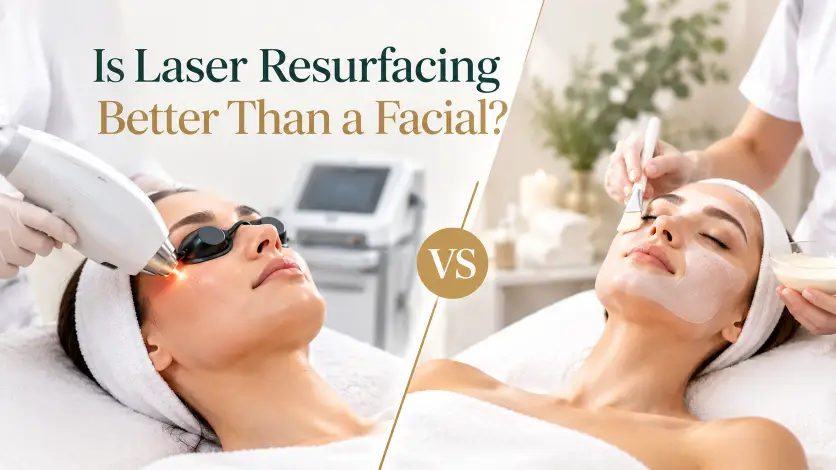
Is Laser Resurfacing Better Than a Facial?
Neither one is universally better because they’re not trying to do the same job.
Facials maintain what’s already working. They exfoliate the surface, hydrate, clear congestion, and keep the skin barrier healthy between bigger interventions. A good regular facial routine keeps skin looking its best on an ongoing basis and addresses what’s happening right now in the skin.
Laser resurfacing corrects what facials can’t reach. Collagen decline in the dermis, melanin accumulated from years of UV exposure, and texture irregularities that live below the surface layer. None of those respond to what happens at the table during a facial. Laser gets into the structure of the skin and triggers changes that take weeks to months to fully develop.
It’s using laser when correction is the goal and facials to maintain the results between sessions. Most patients who complete a laser series at 901 Aesthetics continue with regular facials afterward and notice their skin responds better to both.
When to Schedule Laser Resurfacing in Germantown
Tennessee summers are intense on the skin. UV index in the Memphis area runs high from April through September, and post-laser skin is more sensitive to sun exposure during active healing than untreated skin. Scheduling a treatment series during peak summer and then spending time outdoors increases the risk of post-treatment pigmentation and makes results harder to maintain.
The fall-to-winter window is when most patients at 901 Aesthetics choose to start a resurfacing series. Reduced UV exposure during the healing period makes recovery more straightforward, and patients who start in October or November finish their three-session series healed and showing results by late winter or early spring when most people want their skin looking its best.
This doesn’t mean laser can’t be done in summer. It means scheduling requires more careful sun avoidance before and after each session, and the elōs Plus non-ablative approach is generally more forgiving during warmer months than more intensive treatments.
If fall or winter is your window, a consultation at 901 Aesthetics confirms which device fits your skin before the season starts. Call (901) 221-1256 or book at 901aestheticportal.myaestheticrecord.com.
Laser Skin Resurfacing at 901 Aesthetics in Germantown
901 Aesthetics is at 9057 Valley Crest Lane, Suite 101, Germantown, TN 38138, minutes from the Poplar Avenue corridor. Lauren McCann, MSN, RN, CRNA and the team see patients for laser skin resurfacing in Germantown TN from across East Memphis, Collierville, Cordova, Bartlett, Lakeland, Arlington, Olive Branch, and Southaven. 901 Aesthetics is Voted #1 Memphis Most MedSpa and Laser Center and holds the 2024 Community Choice Award.
One consultation tells you which device fits your skin, what your recovery will actually look like, and how many sessions your concerns realistically need. Book at 901aestheticportal.myaestheticrecord.com or call (901) 221-1256. Cherry financing spreads the series into monthly payments for patients who want to start without the full upfront cost.
For patients building a broader treatment plan alongside resurfacing, the laser services guide for 901 Aesthetics covers every laser option available at the clinic in one place, and laser hair removal in Germantown is frequently combined with a resurfacing series during the same seasonal treatment window.
If you’ve been on the fence about whether laser skin resurfacing for fine lines and sun damage is the right call for your skin, a consultation at 9057 Valley Crest Lane is where that question gets a specific answer, not a general one.
Frequently Asked Questions
Share This Story, Choose Your Platform!
Related Posts