In 2025, a wave of celebrities announced they were dissolving their fillers. Some called it a return to their natural face. Some said they’d gone too far. The photos circulated everywhere, and a lot of people looking into fillers for the first time had the same reaction: Is that what happens?
It isn’t. Not when someone who knows what they’re doing places them correctly. The faces that started trending as cautionary examples all shared something. Puffiness that didn’t move right. Lips that looked like a single inflated unit. Cheeks that sat too high and caught light in a way that skin doesn’t. Those outcomes didn’t happen because dermal fillers are inherently unnatural. They happened because of specific decisions made during treatment. Lauren Linam at 901 Aesthetics in Germantown treats enough patients to know exactly what those decisions are and what to do instead. That’s what this covers.
The Difference Comes Down to One Thing
Dermal fillers can look completely natural. Yes, without much qualification. What determines whether they do is not the product itself. It’s the injector and how they approach the face. An injector who uses the right amount, selects the right product for that specific area, and places it at the correct depth produces a result that enhances what’s already there rather than announcing what changed.
Natural filler results have a specific meaning. The face looks balanced at rest. Not smoother than it should be. Not rounder in a way that doesn’t match the rest of the face. Just proportionate. During expressions, when you’re smiling, raising an eyebrow, or squinting, the face moves normally.
From any angle, the person still looks like themselves. The goal with fillers is not to look like a different person. The goal is for someone who sees you to think you look great, without knowing exactly why.
When fillers miss that mark, it’s almost always because too much product went in, the wrong product went into the wrong area, or placement depth was off. None of those failures are inevitable.
What Makes Filler Look Unnatural
The first is volume. Too much product in a single session is the most common cause. It produces a puffy, rounded appearance that doesn’t move naturally. Overfilled cheeks look spherical rather than structured. Overfilled lips lose their individual shape.
The second is product selection. Different fillers have different consistencies, formulated for specific areas. A thick, dense filler in a delicate area like the lips creates a stiff result that restricts movement and sometimes causes visible ridging. The wrong product in the wrong place produces an unnatural result regardless of how precise the injection was.
The third is placement depth. Filler placed too superficially sits close to the skin surface, where it catches light differently than the surrounding tissue. That’s the shiny, over-smooth appearance that doesn’t match the rest of the face.
A practical way to evaluate results is two tests: the rest test and the movement test. At rest, the face should look balanced and proportionate. During movement, expressions should look unhindered. Natural results pass both. We’ve had patients come in after treatments elsewhere who passed the rest test perfectly and completely failed the movement test. Features that looked fine in a still photo locked up during a real smile. Placement depth, almost every time.
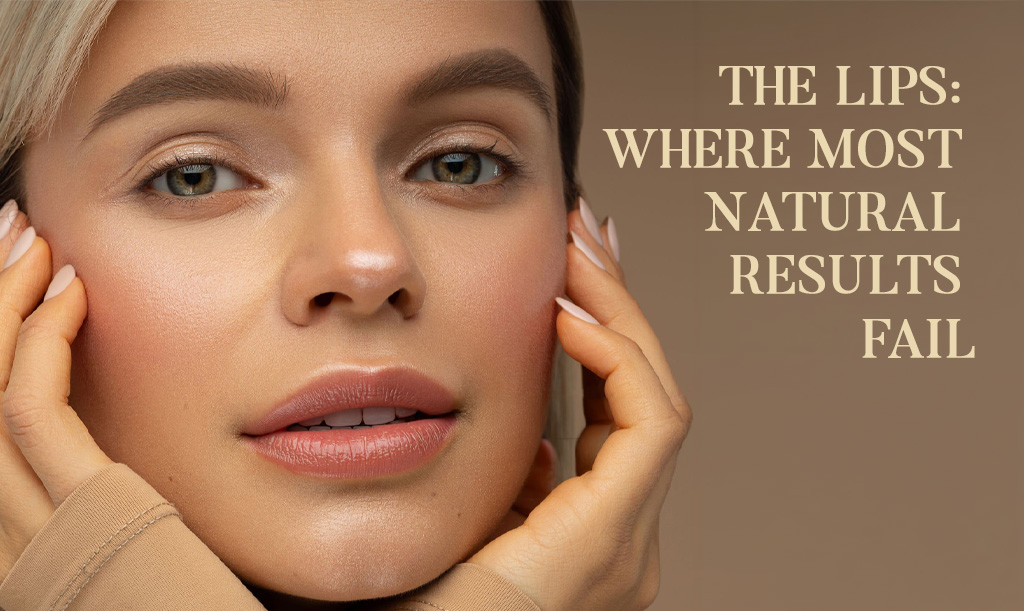
The Lips: Where Most Natural Results Fail
Lips are the area people point to when they say fillers look fake. They’re not wrong. Lips fail more visibly than any other area because the mouth moves constantly. Every word, every expression, every photo shows exactly what’s there.
The most common failure is overprojection of the upper lip. When too much product sits at the border between the lip and the skin above it, the upper lip pushes forward and the natural shadow below the nose disappears. That shadow, the philtrum, is part of what makes lips look like lips rather than something sitting on a face. When it goes, the result reads as filler immediately.
Lips have structure. An upper lip with two peaks and a center dip, a lower lip with its own curve. When the product goes in without respecting that structure, both lips merge into a single smooth form. Inflated rather than full. The shape that made those lips look like that person’s lips is gone.
Good lip filler adds volume in a way that respects the existing architecture, maintains the movement the mouth needs for expression, and fits the proportions of the rest of the face. Bigger is not the point. Lips that look like they belong there are the point.
Lauren has turned down lip filler requests. Not because the patient didn’t want it, but because the face in front of her wasn’t ready for more volume and needed a different conversation first. That’s what a real consultation looks like.
The Right Filler for the Right Area
Not all fillers work the same way. The product matters because different formulations have different physical properties, and those properties determine how filler behaves in tissue.
Hyaluronic acid fillers, the Juvederm, Restylane, Voluma, and Belotero range, come in consistencies from very soft to quite firm. Soft versions work well in mobile areas like the lips because they flex with movement. Firmer versions suit structural areas like the cheeks and jawline where the filler needs to hold its shape. All HA fillers share one important property: they’re reversible. An enzyme called hyaluronidase dissolves them. If you’re not happy with the result, the filler comes out. That option carries real weight for first-time patients.
Radiesse and Sculptra work differently. Both stimulate the body’s own collagen production rather than simply adding volume directly. Radiesse produces an immediate result that transitions into longer-lasting collagen support. Sculptra builds gradually over several months. Neither reverses the way HA fillers do, which is why starting conservatively matters even more with biostimulators.
| HA Fillers (Juvederm, Restylane, Voluma, Belotero) | Biostimulators (Radiesse, Sculptra) | |
|---|---|---|
| How they work | Add volume directly | Stimulate collagen production |
| Results timeline | Immediate | Gradual, weeks to months |
| Reversibility | Yes, with hyaluronidase | No |
| Best suited areas | Lips, under-eyes, cheeks, nasolabial folds | Deeper lines, jawline, structural areas |
| Typical longevity | 6 to 18 months | 12 to 24 months |
Choosing between them is not about which is better. It’s about which suits the area, the goal, and whether you want immediate volume or a gradual collagen rebuild.
How the Whole Face Works Together
Fillers work best when the injector thinks about the whole face, not just the area the patient pointed at. This comes up most often with nasolabial folds, the lines that run from the nose to the corners of the mouth. Patients ask about them constantly, and understandably. Deep ones make someone look older. But filling the fold directly often produces a thick, rope-like result that doesn’t improve the appearance. The fold comes back anyway because the fold isn’t the problem.
What’s happening is higher up. As we age, fat pads in the mid-face descend. Volume shifts downward, the cheeks lose their lift, and the skin settles into folds and starts contributing to jowling. Treating the mid-face at the right structural point lifts the tissue above, softens the fold from the inside, and improves the jawline without touching either of them directly.
A patient came in asking for under-eye filler. Visible hollowing under the eyes, a legitimate concern. But looking at the full face, the hollowing was coming from volume loss in the cheek directly below it. One syringe of Voluma placed in the mid-face addressed the under-eye concern without a single injection near the eye. Treating the cause rather than the symptom. A good injector plans the face over time, not one appointment at a time.

Before Your Appointment: What to Prepare and What to Ask
Most people walk into a filler consultation with a photo of someone else’s face. A celebrity, an influencer, a screenshot. That photo becomes the starting point of the conversation, and the conversation goes sideways from there.
Bring a photo of yourself from ten or fifteen years ago instead. Not because you want to look exactly like that again. Because it shows the injector what your face looked like with its natural volume in place. That’s the reference worth working from.
Beyond the photo, think about the specific thing that bothers you. Not “I want to look younger.” The specific thing. The hollowing under your eyes in certain light. The fold that appeared alongside your mouth. Specifics give the injector something real to work with.
Once you’re in the room, ask questions. What product would you use here, and why? How much would you start with? What happens if I don’t love the result after swelling settles? Can I see photos of actual patients you’ve treated, not stock images?
A good injector answers every one of those without hesitation. An injector who steers you toward a decision before asking about your goals is the wrong injector. And if someone starts recommending more product than you mentioned wanting before they’ve fully assessed your face, that’s the moment to leave.
If you’re not sure what to ask or what to expect at a first filler consultation, Lauren is happy to walk you through it before anything is scheduled. 901 Aesthetics offers in-person and in-home consultations across Germantown, Collierville, and the Memphis area. Book a consultation here.
Natural Filler Results at 901 Aesthetics in Germantown
The fear that brought you here, the one about ending up looking overdone or unrecognizable, is the same thing Lauren hears before almost every first filler consultation. It’s a reasonable fear. The results that circulated online in 2025 earned it. But those results came from specific choices made by specific injectors. Not from the fillers themselves.
At 901 Aesthetics, Lauren approaches every face conservatively, assesses it in full before recommending anything, and starts with less rather than more. You see the results as they settle before anything gets added. In-person and in-home appointments are available throughout Germantown, Collierville, Olive Branch, and the greater Memphis area.
The different types of filler at 901 Aesthetics and the facial contouring approach Lauren uses are covered in more detail if you want to go deeper before booking. When you’re ready to find out what natural results look like for your specific face, start with a consultation. Schedule your filler consultation today.
Share This Story, Choose Your Platform!
Related Posts