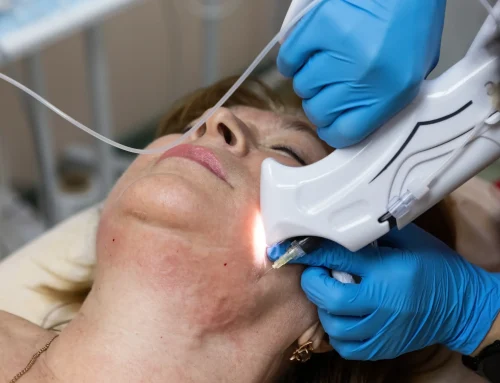
You look in the mirror two months after your lip filler, and something is off. Not bad, exactly. Just different from what it looked like at the two-week mark. There is a soft ridge sitting above your top lip that was not there before. Or you had tear trough filler done and the puffiness under your eyes never really went away. It just settled into something permanent-looking that makes you look tired no matter how much sleep you get.
This is filler migration. Not a medical emergency. Not something to panic over. But something worth understanding before you decide whether to wait it out or pick up the phone. This blog covers the two areas where migration shows up most: the lips and the under-eye.
QUICK ANSWER
Filler migration is when dermal filler moves away from where it was injected and into surrounding tissue, creating fullness, lumps, or discoloration somewhere it was never meant to be. It is not normal post-treatment swelling. Swelling resolves on its own within two weeks. Migrated filler does not.
The most recognizable sign in the lip area is a soft ridge or shelf above the lip border. That’s the defined line between your lip and the skin above it, and when filler migrates across it, the edge blurs. Under the eyes, migrated filler often shows up as persistent puffiness or a bluish tint beneath the skin. Both look different from how the treated area appeared right after the appointment.
Yes, it can be fixed. Hyaluronic acid fillers, which include most of what gets injected for lips and tear troughs, can be dissolved with an enzyme called hyaluronidase. The dissolving process works within 24 to 48 hours for most people. And once it is cleared, the filler can be redone properly if you want it.

Where Filler Migration Actually Happens
Not every area of the face carries the same risk. Migration tends to concentrate in places where the tissue is thin, where the muscles move constantly, or where injectors have to work with very precise anatomical landmarks. The lips and the under-eye area hit all three of those criteria, which is why those two spots come up in almost every conversation about this.
Lip Migration: The Shelf Above the Lip Line
The vermilion border is the defined edge between your lip and the skin above it. It creates the sharp outline that makes lips look crisp and well-shaped. When filler migrates out of the lip and into the tissue above that line, that border softens. Instead of a clean edge, you get a fleshy ridge sitting above the lip. A lot of people call the filler mustache.
In more pronounced cases, the lip starts to roll forward rather than projecting vertically. That forward roll is what creates the appearance people call duck lips. It does not look like too much lip volume. It looks like the volume ended up in the wrong place.
The lips are moving constantly. Every conversation, every meal, every expression works that muscle. That movement does not cause migration on its own, but it amplifies the effect when too much product is placed or when it is injected too close to the skin’s surface. Years of top-up treatments without fully reassessing how much filler is already in the tissue is how the gradual shelf forms in most people who experience it. The filler does not usually migrate in a single dramatic event. It accumulates over months.
Under-Eye Migration: Why the Tear Trough Is Different
The under-eye area is a different challenge. The skin there is the thinnest on the face. Genuinely close to translucent in most people. There is almost no structural cushion between the surface and the tissue underneath. That means filler placed in the tear trough (the hollow that runs from the inner corner of the eye toward the cheek) has very little room for error.
When under-eye filler migration happens, it shows up in two ways. The first is persistent puffiness. A soft, pillowy swelling under the eye that looks like under-eye bags and does not go away with ice or sleep. It feels different from normal swelling. Normal post-filler swelling is soft and spreads evenly. Migrated filler under the eye is firmer in a specific spot and does not change.
The second sign is the Tyndall effect. It is a bluish or grayish tint beneath the skin’s surface. It looks somewhere between a faint bruise and a shadow. The color shows up because hyaluronic acid gel sitting close to the skin’s surface scatters light differently than the surrounding tissue. You will notice it most in bright overhead lighting or in the mirror after a shower. It does not hurt and it is not a bruise, but it does not fade the way a bruise does either.
Tear trough filler is the area where I see the biggest gap between what clients expected and what they ended up with. Not because the treatment does not work. It works beautifully when the product choice and placement depth are right. But the margin for error here is narrower than anywhere else on the face. A fraction of a millimeter in depth makes a visible difference in this skin.

WHAT ACTUALLY CAUSES FILLER TO MIGRATE?
Most cases come down to four things. Not all four need to be present. Sometimes one is enough.
Overfilling is the biggest one. Lips can only hold so much product before the tissue runs out of room to contain it. When the volume exceeds what the anatomy can support, the filler takes the path of least resistance and spreads outward. This is especially common in people who have been getting regular top-up appointments for years without ever stepping back to assess how much product has accumulated. Each session added a little. Nobody dissolved anything. Eventually the total volume in the area quietly crossed a line.
Injection depth matters more than most clients realize. Different products are designed to sit at different layers within the tissue. Filler placed too close to the skin surface sits in a zone with no structural anchoring beneath it. The face moves constantly and the product shifts. Under the eyes especially, a fraction of a millimeter in placement depth separates a beautiful result from something that looks wrong six weeks later.
Product choice is the third factor. A filler formulated for structural work in the jawline or cheeks is built to resist movement. It is stiffer and holds its shape. Put that same product in the lips, where the tissue is soft and mobile, and you create a mismatch. The filler does not integrate smoothly, and the movement of the mouth works against it over time. Softer formulations like Restylane or Juvederm work for lips specifically because they move with the tissue rather than against it.
The fourth factor is injector experience. An experienced injector knows how these variables interact. They know which product to use, how deep to place it, when to stop adding volume, and how to read whether an existing accumulation needs to be addressed before adding anything new. That last point is the one that gets skipped most often. Walking into a session without first assessing what is already in the tissue from previous appointments is how gradual migration builds without anyone noticing.
IS IT MIGRATION OR JUST SWELLING? HOW TO TELL
Swelling resolves. Migration does not. That is the core distinction and everything else flows from it. After filler, swelling peaks within 24 to 72 hours. By two weeks it is mostly gone. If something looks off at the two-week mark but you can still feel it changing and softening, give it a little more time. If at the four-week mark you still have firmness, fullness, or asymmetry in a specific spot, that is worth getting looked at. The table below makes this easier to check against what you are seeing.
Migration vs. Normal Swelling: How to Tell
| Normal Swelling | Filler Migration | |
|---|---|---|
| When it appears | First 24 to 72 hours after treatment | Weeks or months after treatment |
| How it feels | Soft, fluid-like, dispersed | Firm in a specific spot, does not change |
| Symmetry | Spreads evenly across the treated area | Often affects one side more than the other |
| Ice or elevation | Helps reduce it | Makes no difference |
| At four weeks | Resolved or nearly resolved | Still present, possibly more noticeable |
| What to do | Wait it out | Book an assessment |
One thing worth knowing: migrated filler in the lip area sometimes feels like a cord or a ridge you can press with your finger. Normal swelling never does that. If you can feel a firm line above your lip border that does not give when you press it, that is not post-treatment settling.
Watch and Wait vs. Call Your Provider
| What You’re Seeing | What It Probably Means |
|---|---|
| Swelling within the first week, symmetrical | Normal. Wait two weeks. |
| Firmness in one specific spot at 4 weeks | Get it assessed. |
| Asymmetry that appeared after the swelling resolved | Get it assessed. |
| A ridge or shelf above the lip that was not there at 2 weeks | Call. |
| Blue-grey tint under the eye that has not faded | Call. |
| Results look different now than they did at 2 weeks | Worth a conversation at minimum. |
Most people wait too long because they hope it will sort itself out. It rarely does. Catching migration early makes correction simpler.
CAN MIGRATED FILLER BE FIXED?
Yes. Hyaluronic acid filler, the gel-like substance inside products like Juvederm, Restylane, Voluma, and Belotero, can be dissolved with an enzyme called hyaluronidase. The enzyme breaks down the hyaluronic acid in the filler and allows the tissue to clear it. Most people see visible change within 24 to 48 hours. The full result settles over four to seven days.
Your face will likely look a little worse before it looks better. The dissolving process causes temporary swelling and sometimes bruising in the treated area. You will probably look slightly puffier for a day or two than you did going in. That is the tissue responding to the enzyme, not a sign something went wrong. By day three or four, the swelling drops and you start to see what the tissue looks like without the migrated product.
The waiting period matters. Providers recommend waiting four to six weeks before injecting new filler after a dissolving session. The tissue needs time to stabilize. Trying to re-treat too soon means injecting into a tissue environment that is still in flux, which makes accurate placement harder and increases the chance of the same problem repeating.
At 901 Aesthetics in Germantown, Lauren McCann, CRNA, performs injectable treatments and assessments. Her background in anesthesia means she understands nerve block techniques, which makes dissolving sessions more comfortable than they tend to be at clinics without that level of clinical training. Hyaluronidase injections sting. That is just the reality of the procedure. But they sting considerably less when a provider with anesthesia training is managing the process.
One more thing worth knowing for people who have had filler from multiple providers over several years. Accumulation builds slowly. You may have more product in an area than you or anyone else realized, because each appointment added to what was already there without clearing it first. A dissolving session in that situation is not just a correction. It is a reset. A chance to reassess what your face actually needs and re-treat from a clean baseline. A lot of people find that after dissolving, their face looks more natural than it has in years.
HOW TO PREVENT FILLER MIGRATION BEFORE IT STARTS
The most effective prevention is choosing the right injector before any product goes in. Everything else follows from that. A provider with real anatomical training knows which product belongs in which area, how deep to place it, and critically, when to stop. That last part is the most important and the least discussed. Knowing when to stop adding volume is a skill. It requires confidence in the result you have and restraint in the face of a client who wants more. Providers who lack experience tend to err toward adding product because it feels like doing something. Experienced providers hold back when the anatomy tells them to.
On your end, there are a few things you can control.
Build volume across sessions, not in one appointment. If you want more fullness in your lips, getting half a syringe, waiting a month, then assessing is safer than getting a full syringe the first time. The tissue needs time to show its response.
Tell your provider your full filler history before the appointment, not just your most recent one. How much product has been placed over the years, and where, matters for what happens next. An injector going in without that history is working with incomplete information.
For the first 48 hours after treatment, avoid intense exercise, saunas, and anything that involves pressing on or massaging the treated area. The filler is still integrating. Movement and heat in this window do not cause migration on their own, but they reduce the stability the filler needs to set properly.
And if you have been getting regular filler appointments for several years across multiple providers, it is worth scheduling a straightforward assessment before your next top-up. Not to alarm you. But the conversation about what is already there is one that happens too late more often than it should. At 901 Aesthetics, Lauren sees clients from across the Germantown and East Memphis area for exactly this kind of honest assessment before any new product is placed. The conversation usually takes fifteen minutes and saves a lot of guesswork.
CONCLUSION
You came to this page looking in a mirror and wondering. That ridge above your lip. The puffiness under your eye that sleep doesn’t fix. Now you at least know what you’re looking at and what the options are.
If you’re in Germantown, East Memphis, Collierville, or anywhere in the Memphis area and you want someone to take a look, Lauren McCann, CRNA at 901 Aesthetics, is worth calling. She doesn’t push product. She assesses what’s there and tells you what she’d actually recommend. Sometimes that’s dissolving. Sometimes that’s doing nothing yet. Sometimes it’s a different approach entirely.
Call (901) 221-1256 or book your consultation online. A fifteen-minute conversation saves a lot of guessing.
Share This Story, Choose Your Platform!
Related Posts